
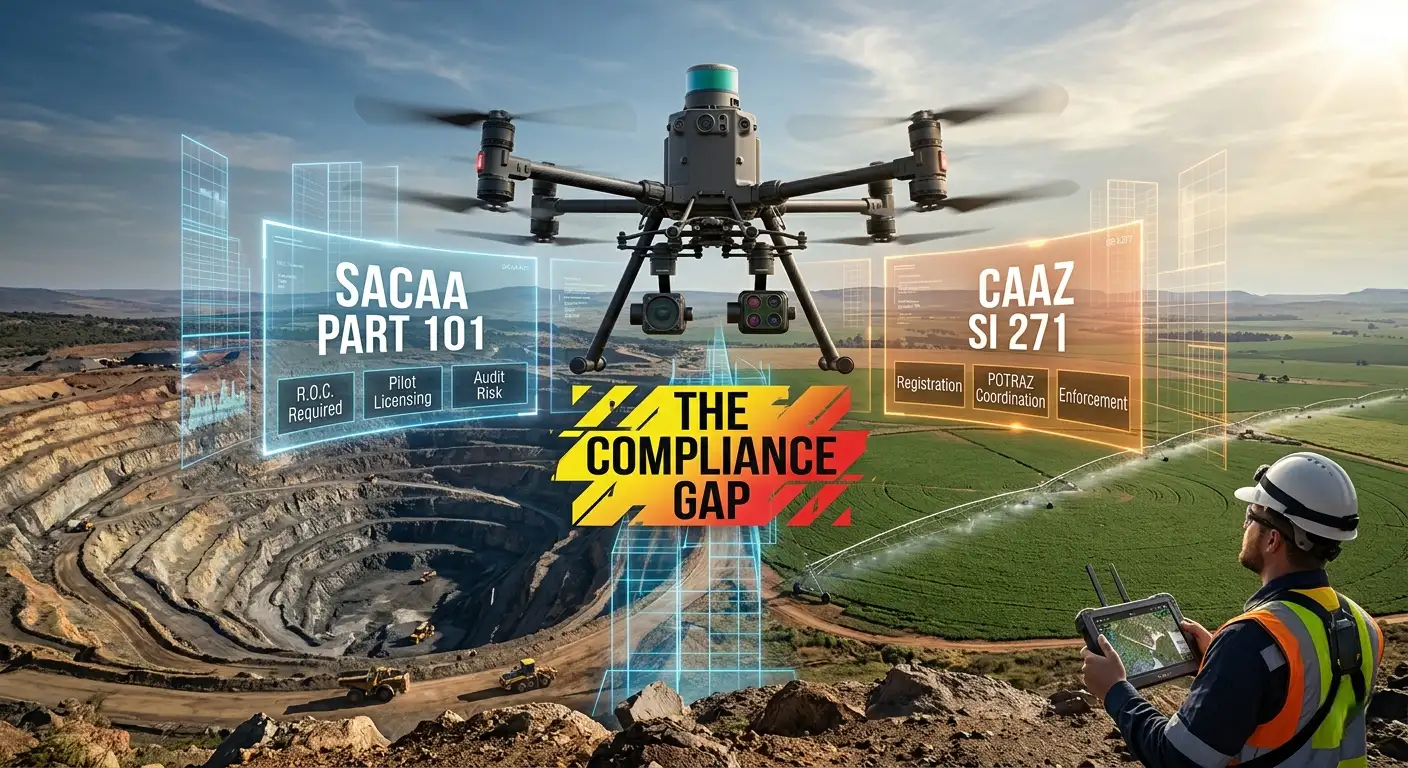
The Drone Compliance Gap in Southern African Mining and Agriculture
Drones have already proven their worth in Southern African mining and agriculture. A mine site that once needed days to measure a stockpile can now get the same answer from a single flight. A farmer who once walked fields row by row can now see crop stress patterns from the air before they are visible on the ground. The technology side of this story is, by now, well established.
The compliance side has not kept pace, and not always for the reason most people assume. Some operators are simply unaware that the rules apply to them. Others know exactly what is required and have made a calculated decision that full compliance costs more than the risk of being caught. Both patterns are worth understanding before any organisation builds a drone programme of its own.
The compliance side has not kept pace, and not always for the reason most people assume. Some operators are simply unaware that the rules apply to them. Others know exactly what is required and have made a calculated decision that full compliance costs more than the risk of being caught. Both patterns are worth understanding before any organisation builds a drone programme of its own.
Where Drones Are Already Earning Their Place
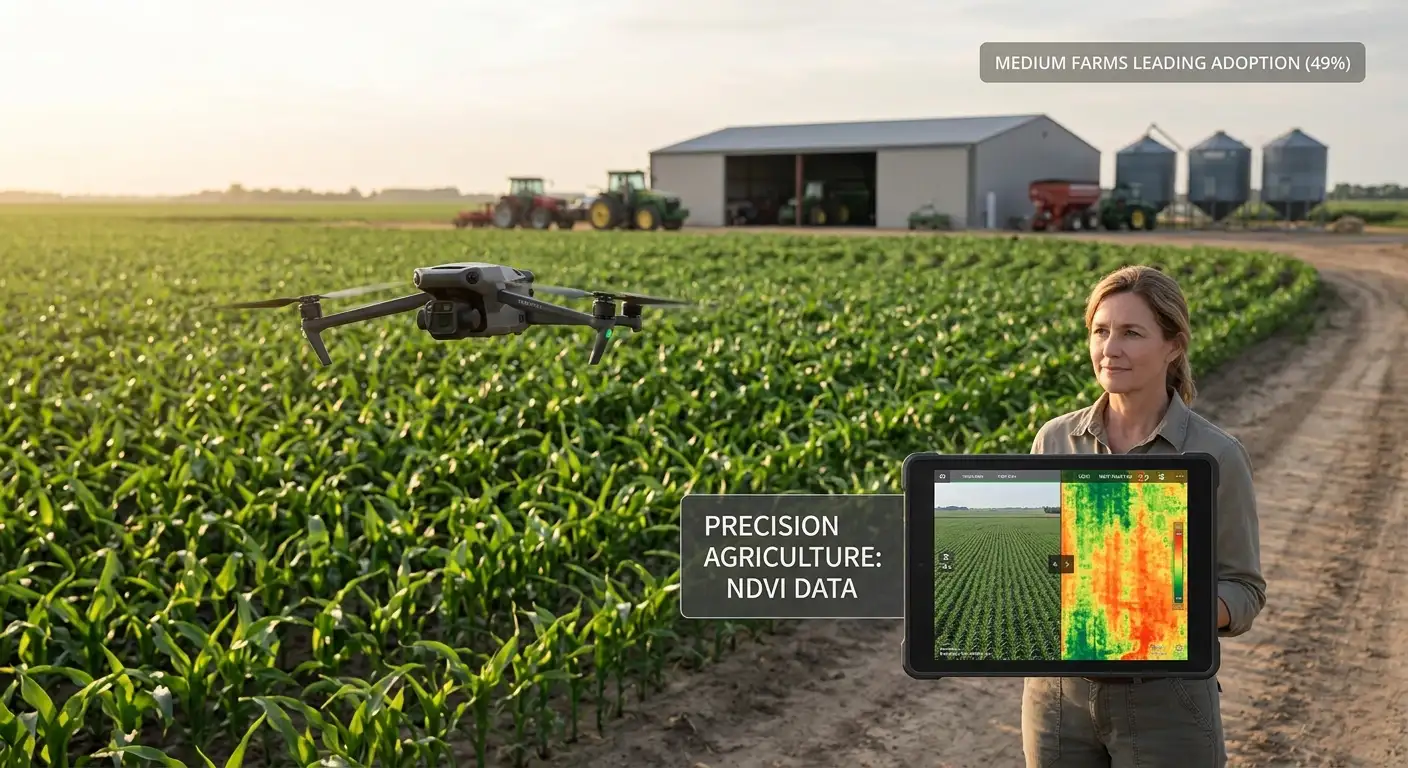
Medium-sized farming enterprises are currently driving drone adoption in agriculture (49%), utilizing NDVI imagery and soil mapping to inform planting and harvesting decisions.
In mining, the most established applications are surveying and mapping, infrastructure inspection, and data collection covering stockpile volumes, mineral reserves, and environmental monitoring. Drones provide high-resolution aerial imagery that improves the accuracy of geographical data collection, support infrastructure inspection without the need for scaffolding or manual labour, and gather stockpile volume, mineral reserve, and environmental data that feed directly into inventory management and resource allocation decisions.
In agriculture, the picture is similar. South African farms have increasingly turned to drones for surveying fields and precision agriculture, including identifying crop stress through NDVI imagery, alongside crop monitoring and mapping. Drones are also being used for soil mapping, giving farmers faster, more detailed data than traditional manual surveys and supporting better decisions on planting, watering, and harvesting.
What's genuinely interesting is who's actually adopting this technology. A recent South African study found medium-sized farming enterprises leading drone adoption at close to 49%, ahead of large farms at roughly 29%, while small farms sat at around 21% and very small farms trailed at about 13%. That complicates the easy assumption that drone adoption is purely a function of size and capital. The operators leading the curve aren't necessarily the ones with the largest compliance departments to manage what comes with it.
In agriculture, the picture is similar. South African farms have increasingly turned to drones for surveying fields and precision agriculture, including identifying crop stress through NDVI imagery, alongside crop monitoring and mapping. Drones are also being used for soil mapping, giving farmers faster, more detailed data than traditional manual surveys and supporting better decisions on planting, watering, and harvesting.
What's genuinely interesting is who's actually adopting this technology. A recent South African study found medium-sized farming enterprises leading drone adoption at close to 49%, ahead of large farms at roughly 29%, while small farms sat at around 21% and very small farms trailed at about 13%. That complicates the easy assumption that drone adoption is purely a function of size and capital. The operators leading the curve aren't necessarily the ones with the largest compliance departments to manage what comes with it.
Two Regulatory Frameworks, Not One Regional Standard
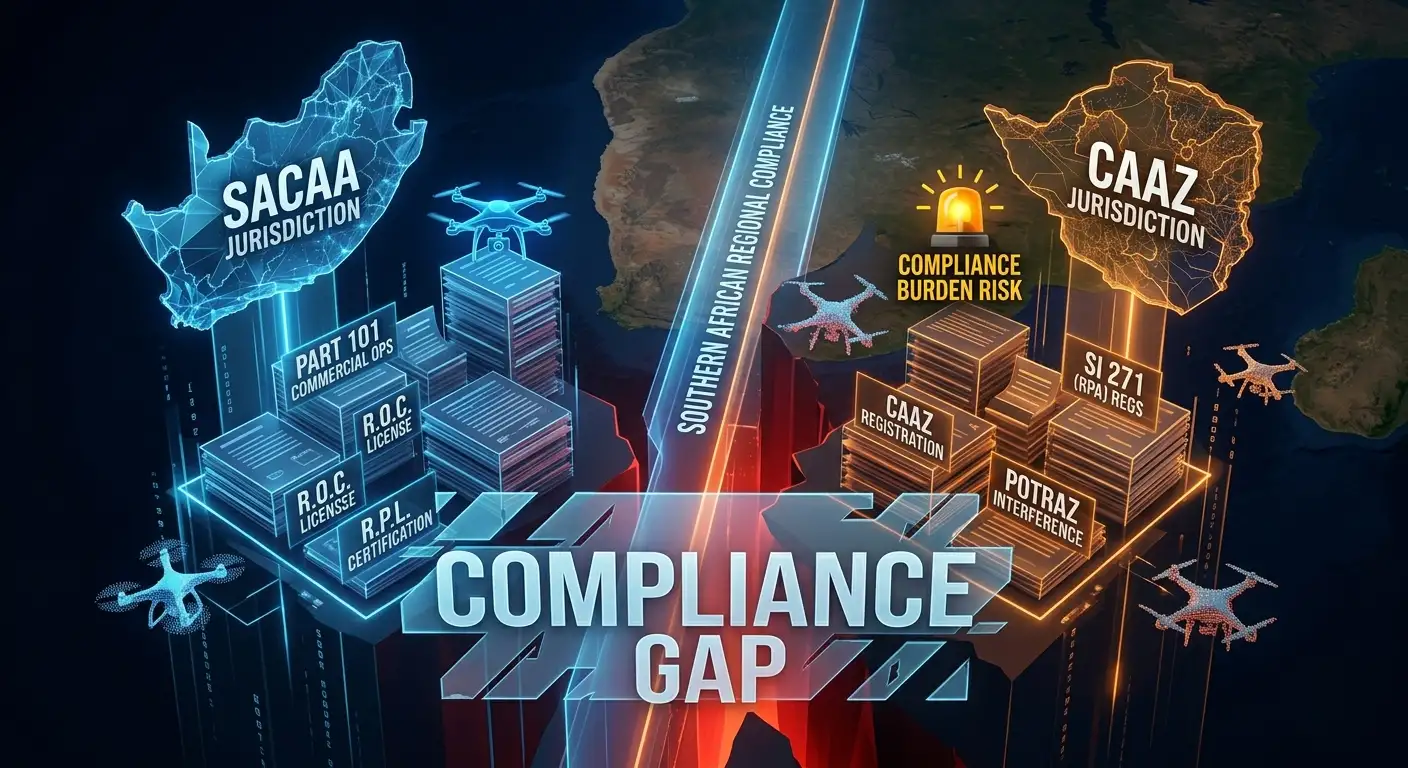
South Africa (SACAA Part 101) and Zimbabwe (CAAZ SI 271) operate under distinct regulatory frameworks, requiring tailored compliance strategies for cross-border operators.
It's worth being precise here, because South Africa and Zimbabwe aren't running the same playbook.
South Africa
Under Part 101 of the Civil Aviation Regulations, all drones used for commercial purposes must be registered with SACAA, and operators must hold a Remote Operator Certificate, while pilots must hold a Remote Pilot Licence, which involves theoretical exams, practical competence, and medical fitness requirements. Altitude and no-fly zone restrictions apply on top of that, and the distinction between commercial and recreational use determines which of these requirements actually bite.
Zimbabwe
Drone operations in Zimbabwe are regulated under the Civil Aviation (Remotely Piloted Aircraft) Regulations, Statutory Instrument 271 of 2018, with all drones required to register with CAAZ and subject to restrictions, including a five-kilometre no-fly zone around airports and a maximum altitude of 120 metres in uncontrolled airspace. CAAZ also works alongside the Postal and Telecommunications Regulatory Authority of Zimbabwe to manage potential interference with telecommunications, and operators must comply with the Data Protection Act when collecting data that could be considered personal information.
South Africa
Under Part 101 of the Civil Aviation Regulations, all drones used for commercial purposes must be registered with SACAA, and operators must hold a Remote Operator Certificate, while pilots must hold a Remote Pilot Licence, which involves theoretical exams, practical competence, and medical fitness requirements. Altitude and no-fly zone restrictions apply on top of that, and the distinction between commercial and recreational use determines which of these requirements actually bite.
Zimbabwe
Drone operations in Zimbabwe are regulated under the Civil Aviation (Remotely Piloted Aircraft) Regulations, Statutory Instrument 271 of 2018, with all drones required to register with CAAZ and subject to restrictions, including a five-kilometre no-fly zone around airports and a maximum altitude of 120 metres in uncontrolled airspace. CAAZ also works alongside the Postal and Telecommunications Regulatory Authority of Zimbabwe to manage potential interference with telecommunications, and operators must comply with the Data Protection Act when collecting data that could be considered personal information.
Why the Compliance Gap Exists, and It Cuts Both Ways
The first reason is straightforward: a meaningful share of operators, particularly smaller agricultural contractors offering survey or spraying services, simply don't realise the full extent of what applies to them once a flight becomes commercial rather than recreational.
The second reason is less comfortable, and more interesting. Industry critics have argued that South Africa's Part 101 framework was finalised without proper engagement with industry representative bodies, and that the resulting compliance burden reduced what was once a fast-growing sector to a small number of operators willing to absorb the cost, effectively pushing the rest toward informality. Whether or not that critique is entirely fair, it points to something real: when the cost of full compliance is high relative to a small operator's margins, part of the market simply doesn't comply, not out of ignorance, but out of arithmetic.
Either way, the result is the same gap. The reasons behind it just point to two different conversations, and an organisation working with drone contractors needs to know which one it's actually dealing with.
The second reason is less comfortable, and more interesting. Industry critics have argued that South Africa's Part 101 framework was finalised without proper engagement with industry representative bodies, and that the resulting compliance burden reduced what was once a fast-growing sector to a small number of operators willing to absorb the cost, effectively pushing the rest toward informality. Whether or not that critique is entirely fair, it points to something real: when the cost of full compliance is high relative to a small operator's margins, part of the market simply doesn't comply, not out of ignorance, but out of arithmetic.
Either way, the result is the same gap. The reasons behind it just point to two different conversations, and an organisation working with drone contractors needs to know which one it's actually dealing with.
What's Actually at Risk When Compliance Is Skipped
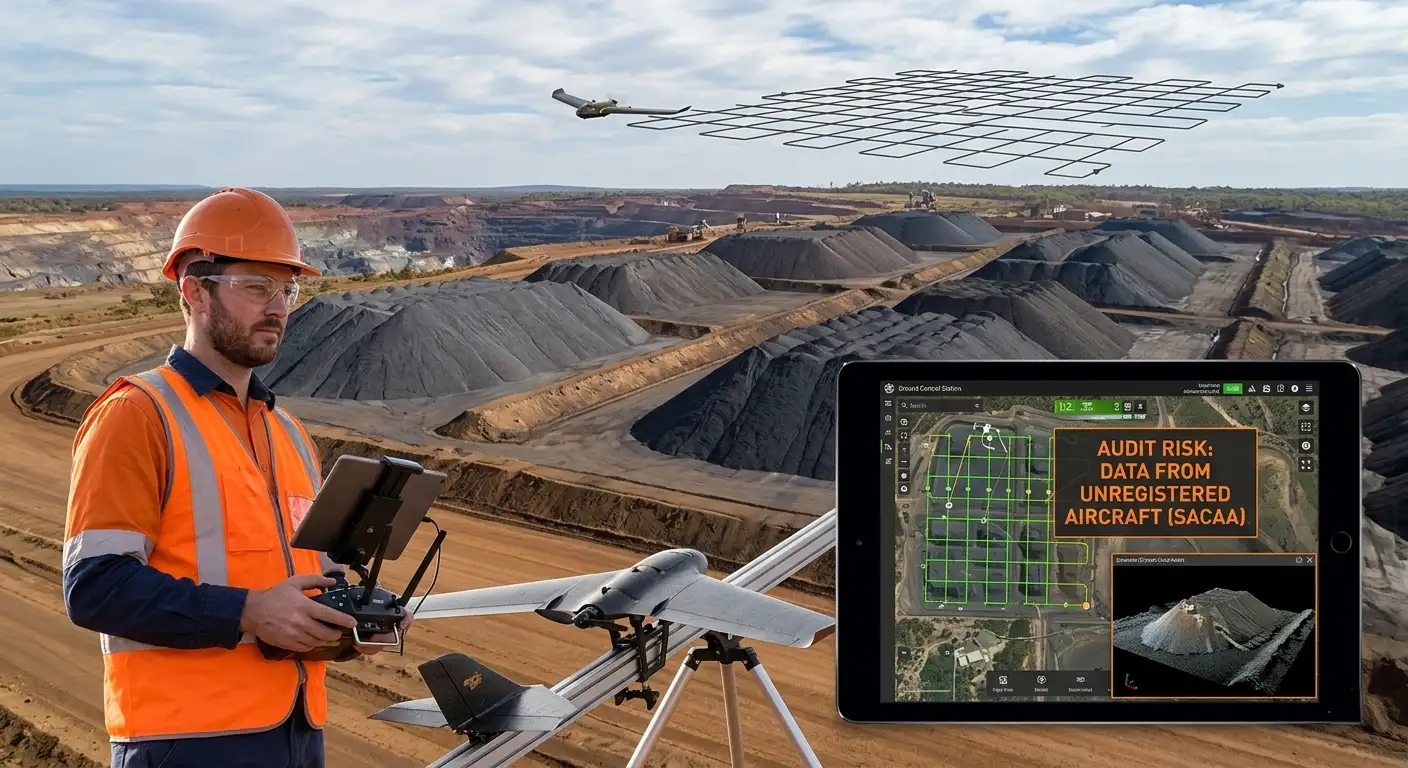
For mining houses, the greatest regulatory exposure often lies in the audit trail of the data collected, rather than the flight itself.
For a mining house, the most consequential risk is rarely the drone flight itself. It's what the data from that flight gets used for afterwards. Stockpile and reserve figures that feed into investor reporting or audit processes carry more weight, and more exposure, if the underlying collection method can't be shown to have followed an approved process.
Then there's the legal exposure. Enforcement in Zimbabwe has included drones being confiscated at airports where operators hadn't secured the proper approvals. South Africa's penalties for non-compliant commercial operation carry similar weight, including fines and, in serious cases, criminal liability.
The least understood risk is privacy. Drones used for monitoring, inspection, or surveillance in South Africa must comply with aviation regulations and, separately, with the Protection of Personal Information Act when the data collected includes anything that could identify individuals. Most drone programmes built around stockpile measurement or crop health aren't thinking about this dimension at all, simply because the camera was never pointed at people on purpose.
Then there's the legal exposure. Enforcement in Zimbabwe has included drones being confiscated at airports where operators hadn't secured the proper approvals. South Africa's penalties for non-compliant commercial operation carry similar weight, including fines and, in serious cases, criminal liability.
The least understood risk is privacy. Drones used for monitoring, inspection, or surveillance in South Africa must comply with aviation regulations and, separately, with the Protection of Personal Information Act when the data collected includes anything that could identify individuals. Most drone programmes built around stockpile measurement or crop health aren't thinking about this dimension at all, simply because the camera was never pointed at people on purpose.
Building a Compliant Drone Programme: A Practical Starting Point
Start with the use case, not the drone. Define exactly what data the programme needs to produce and how it will be used before selecting hardware. The regulatory exposure follows from the use case, not the other way round.
Map the actual regulatory exposure, country by country. Registration, pilot licensing, safety documentation, and privacy obligations differ between South Africa and Zimbabwe. A compliance approach built for one doesn't automatically transfer to the other.
Treat the safety case as a living document. On an active mine site in particular, operating conditions change. A safety case approved at the start of a programme can quietly stop reflecting reality within months if nobody revisits it.
Map the actual regulatory exposure, country by country. Registration, pilot licensing, safety documentation, and privacy obligations differ between South Africa and Zimbabwe. A compliance approach built for one doesn't automatically transfer to the other.
Treat the safety case as a living document. On an active mine site in particular, operating conditions change. A safety case approved at the start of a programme can quietly stop reflecting reality within months if nobody revisits it.
What This Means for Mining and Agriculture Operators
- Mining houses: as aerial data increasingly feeds reserve estimates and investor-facing reporting, the legal defensibility of how that data was collected is becoming as relevant as the operational efficiency it delivers.
- Commercial farms: the operators leading adoption, medium-sized farms, are often the ones with the least internal capacity to manage regulatory risk relative to large agribusiness, which makes this worth addressing early rather than after the fact.
- Third-party drone service providers: mining and agriculture clients should verify a contractor's compliance status as part of due diligence, not assume it because the contractor showed up with professional-looking equipment.
Closing Thought
The question facing Southern African mining and agriculture isn't whether drones are worth using. That case has already been made, repeatedly, in the field. The open question is whether compliance discipline can catch up with an adoption curve that's been moving for almost a decade. That gap, whether it comes from operators who didn't know the rules or from rules that made compliance harder than the risk justified, has been sitting there since the regulations were first introduced, and it hasn't closed on its own yet. YottaVate's Aviation Consulting practice works directly with mining and agricultural operators on exactly this kind of drone compliance review
Frequently Asked Questions
Do you need a licence to fly a drone commercially in South Africa or Zimbabwe?
Yes, in both countries. South Africa requires a Remote Pilot Licence and Remote Operator Certificate under Part 101 of the Civil Aviation Regulations for commercial operations. Zimbabwe requires drone registration and a Letter of Approval from CAAZ under SI 271 of 2018.
What's the difference between SACAA and CAAZ drone regulations?
Both follow a broadly similar structure, registration, licensing, altitude limits, and no-fly zones around airports, but they're separate regulatory regimes with different documentation requirements. CAAZ also coordinates with Zimbabwe's telecoms regulator on interference, while South Africa's framework is further along on issues such as beyond-visual-line-of-sight operations, currently under review.
Is South Africa's drone regulation actually too strict?
That's genuinely contested. Some industry voices argue that Part 101 was developed without sufficient industry consultation and imposes compliance costs disproportionate to the actual risk, particularly for smaller operators. SACAA's position is that the framework balances innovation against safety and privacy. Both views have some merit, and operators should be aware that the debate exists rather than assuming the rules are settled.
What happens if a mining or agriculture operator is found non-compliant?
Consequences range from fines and equipment confiscation to criminal liability in serious cases, alongside reputational and audit risk if non-compliant aerial data has fed into operational or investor reporting.
Yes, in both countries. South Africa requires a Remote Pilot Licence and Remote Operator Certificate under Part 101 of the Civil Aviation Regulations for commercial operations. Zimbabwe requires drone registration and a Letter of Approval from CAAZ under SI 271 of 2018.
What's the difference between SACAA and CAAZ drone regulations?
Both follow a broadly similar structure, registration, licensing, altitude limits, and no-fly zones around airports, but they're separate regulatory regimes with different documentation requirements. CAAZ also coordinates with Zimbabwe's telecoms regulator on interference, while South Africa's framework is further along on issues such as beyond-visual-line-of-sight operations, currently under review.
Is South Africa's drone regulation actually too strict?
That's genuinely contested. Some industry voices argue that Part 101 was developed without sufficient industry consultation and imposes compliance costs disproportionate to the actual risk, particularly for smaller operators. SACAA's position is that the framework balances innovation against safety and privacy. Both views have some merit, and operators should be aware that the debate exists rather than assuming the rules are settled.
What happens if a mining or agriculture operator is found non-compliant?
Consequences range from fines and equipment confiscation to criminal liability in serious cases, alongside reputational and audit risk if non-compliant aerial data has fed into operational or investor reporting.