

Engineering Failure Into the Plan: A Different Way to Think About Business Risk
Engineers build differently. Before anything is allowed to fly, an aeronautical engineer maps every single thing that could go wrong with a system and designs against it deliberately, rather than hoping none of it happens. This discipline has a name: failure mode analysis. It is not a metaphor borrowed for a business article. It is a specific, repeatable method that translates into business planning far more directly than most leaders realise.
What Failure Mode Analysis Actually Is
Where It Comes From
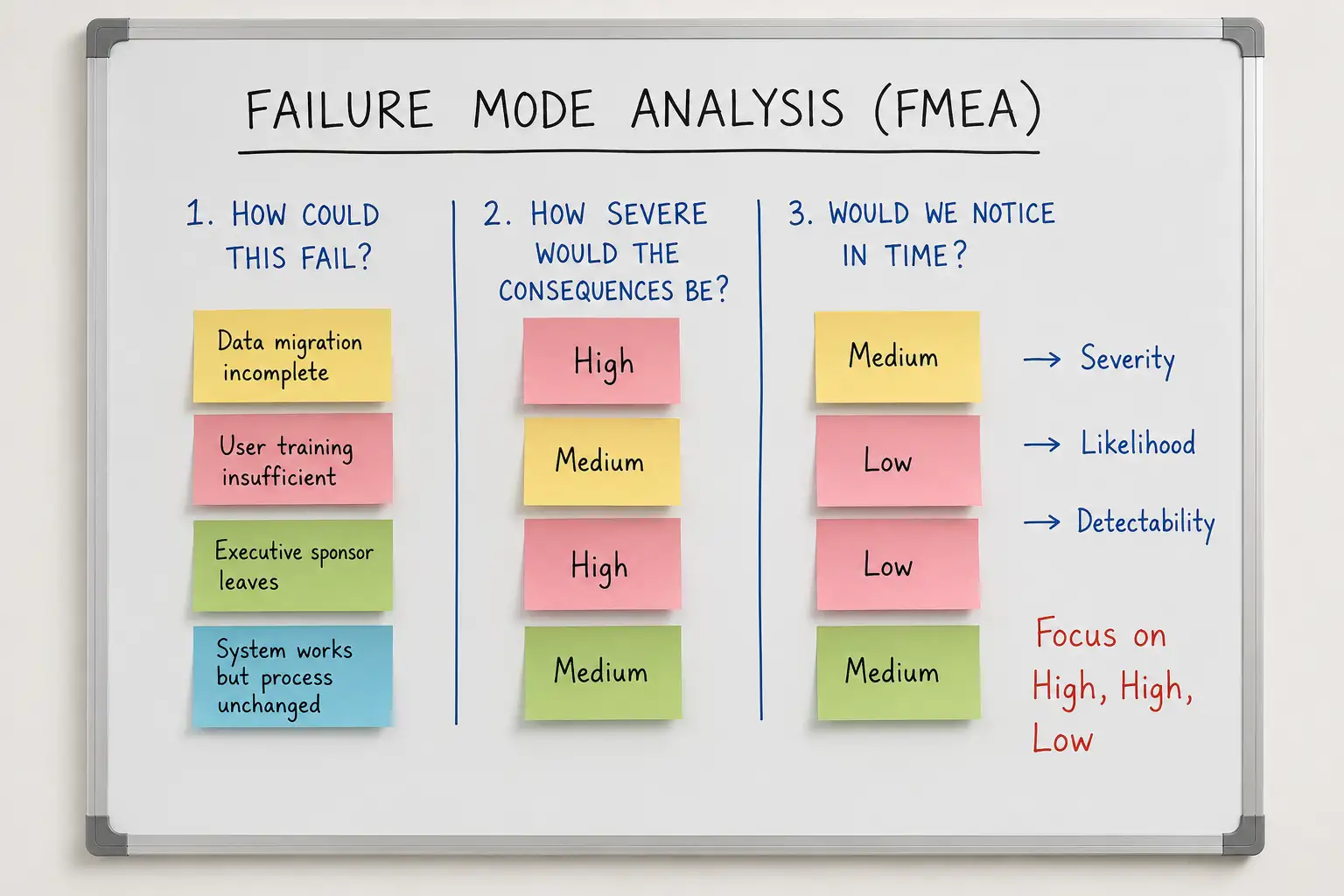
Structured failure analysis helps organisations move beyond generic risk categories and focus on specific, actionable vulnerabilities.
The Core Logic
- How could this fail?
- How serious would the consequences be if it did?
- Would we notice in time to act, or would the failure go undetected until the damage was done?
Why Most Business Strategies Skip This Step
The result is a familiar pattern. An organisation invests significant time and money, runs into a problem six months in, and describes it as unexpected. In hindsight, it rarely is. Most strategic failures were entirely visible in advance to anyone who deliberately looked for them. The problem was never a lack of intelligence in the room. It was that nobody was tasked with finding the failure before it found them.
Three Failure Modes That Show Up Again and Again in Business Transformation
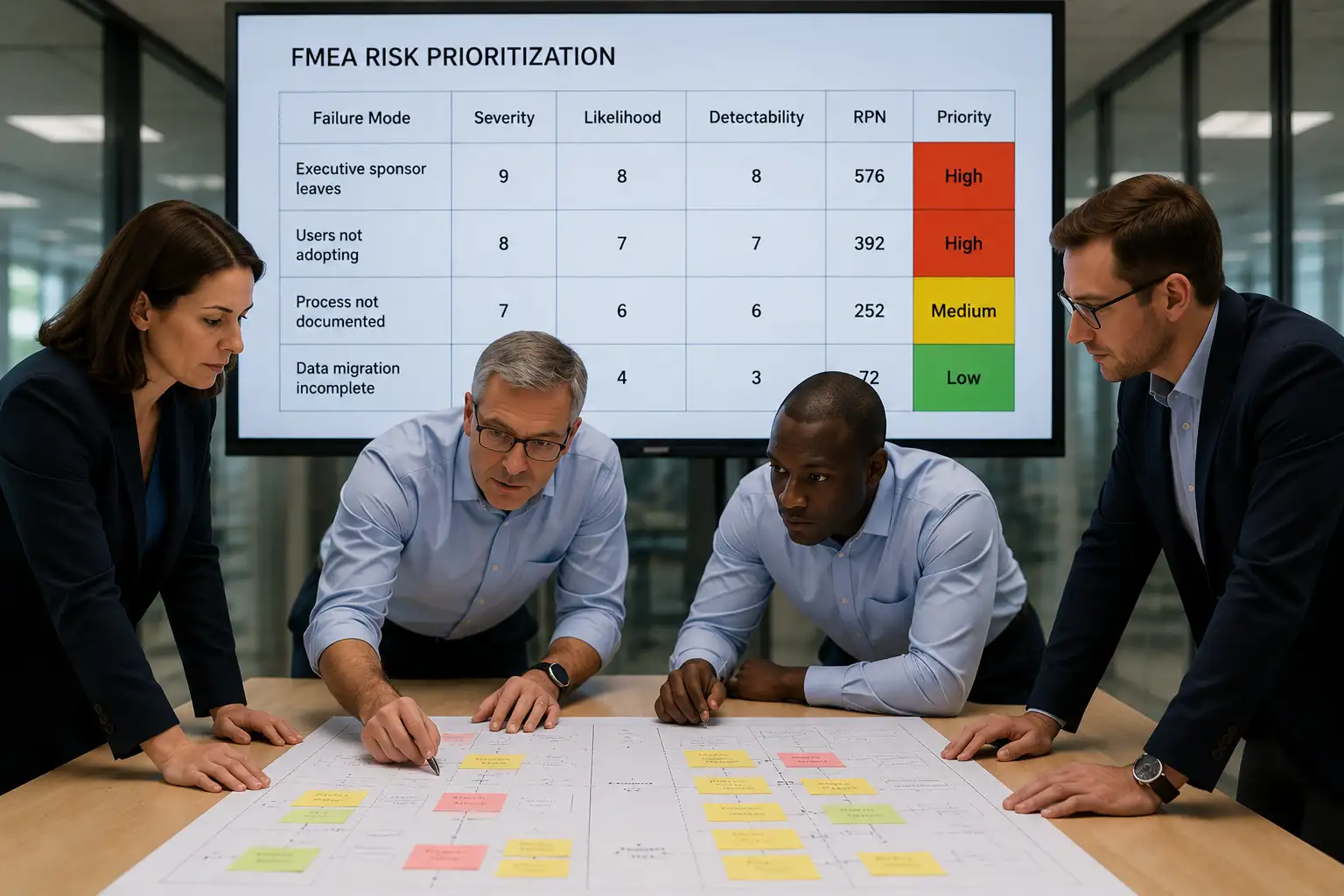
Effective transformation programmes begin by identifying what could derail success before committing resources to implementation.
- The technology performs exactly as designed, but the people who are meant to use it daily were never genuinely brought into the change, so adoption never really happens.
- The process being digitised was never properly documented in the first place, so the new system simply automates an inconsistency that was previously invisible.
- The executive sponsor who opened doors and unblocked decisions in month one is no longer actively involved by month four, and the project quietly loses its authority to make hard calls.
Why This Discipline Matters Even More in High-Stakes Environments
Building Failure Mode Thinking Into Your Own Planning
- Name the specific failure, not the vague category. "Adoption risk" tells you nothing useful. "Branch staff revert to the old spreadsheet because the new system takes three extra clicks", tells you exactly what to fix.
- Score it, rather than simply feeling uneasy about it. A rough rating of severity, likelihood, and detectability is enough to separate failures worth designing around from those worth simply monitoring.
- Build the response into the plan itself, with an owner and a checkpoint, rather than parking it in an appendix nobody reopens.
Closing Thought
Frequently Asked Questions
What is Failure Mode Analysis (FMEA)?
It is a structured risk methodology, originally developed in aerospace and defence engineering, that identifies every plausible way a system or process could fail before it is built or implemented, then rates each failure by severity, likelihood, and ease of detection.
How is this different from a standard business risk register?
Most risk registers list broad, generic categories such as "market risk" or "execution risk." Failure mode thinking requires naming the specific failure mechanism, rating it honestly, and integrating the mitigation directly into the implementation plan rather than storing it separately.
Can this be applied outside engineering and aviation?
Yes. The underlying logic, specific failure naming, honest rating, and built-in mitigation apply to any planning exercise where getting it wrong has real consequences, including digital transformation, market entry, and large capital projects.
How do you decide which failure modes actually matter?
Focus on the failures that combine high severity, high likelihood, and low detectability. A severe but easy-to-spot failure is far less dangerous than a moderately severe one that remains nearly invisible until it has already caused damage.